
Contents
- Alternative Provision
- Annual Review
- Appeals & Mediation
- Attendance/Not in full time education
- Benefits
- Complaints
- Disability Discrimination
- Education other than in school/college
- Education, Health and Care Plans
- Elective Home Education (EHE)
- Exclusions
- Health
- How should the Local Authority help
- Neurodiversity
- Personal Budgets
- SEN Support in nurseries, schools and colleges
- Service Families
- Social Care
- Transport
- Year 6 Transition
- Young People’s Page
SEN Support in nurseries, schools and colleges
A child has Special Educational Needs (SEN) if he or she has a learning difficulty or disability which calls for special education provision to be made for him or her. (Click here to read about this in more detail including exploring the definitions in italics).
Nurseries, schools and colleges should identify and support children and young people with SEND.
Children and young people in mainstream settings may be supported from within the school or other setting’s own resources.
We have created this helpful video to help you understand the difference between Ordinarily Available Provision (also referred to as Universal Provision, universal and targeted OAP, or Quality First Teaching) and SEN Support. We look at who is entitled to each level of support, and when and how they should be used across all educational settings.
When your child is identified has having SEND, the school should use a “graduated approach” to support them and should make a record of each stage of the cycle. Parents should be involved and consulted at every stage:
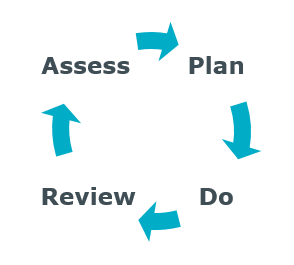
Assess:
Record the SEN they have identified your child as having through their observations and assessments. Sometimes other professionals will be involved in assessments.
Plan:
Plan the outcomes they expect to be achieved by your child, and what provision they will put in place to reach those outcomes,
Do:
Implement the plans
Review:
Review the child’s progress toward outcomes and the difference the support has made. Undertake new assessments and update outcomes and plans as required.
One of the key duties is for the nursery, school or college to use their ‘best endeavours’ to support children and young people with SEN. This means doing everything that could reasonably be expected of them.
All mainstream schools have money for SEN support and resources. Schools can decide how they spend this money, also known as delegated funding.
If your child’s mainstream school or college cannot meet their needs through the ‘graduated approach, then they should request an Education, Health and Care Needs Assessment.
The Hampshire LA have created the following resources to help:
- SEN Support Guidance for Early Years Providers. Click here to read.
- Ordinarily Available Provision Guidance for Early Years Providers. Click here to read.
- An information page to support ‘Transitions for Children in Early Years’. This page is for a children starting an early years setting, moving between settings and school or starting a new setting due to a move from out of area. Click here to read
- SEN Support Guidance for Schools & Colleges details how mainstream settings are expected to support children with SEND. Click here to read.
- Information on Ordinarily Available Provision and SEND Support, the support every child should be receiving to help all young people to learn and enable them to reach their full potential. Click here to read.
- A range of services that can schools can access from the Local Authority so children and young people remain at the centre of every discussion. Click here to see a list with links.
Additional Resources:
We’re sharing a set of practical tools to support young people. These include simple, evidence-informed classroom adjustments that can help reduce anxiety, prevent barriers to education, and inspire collaborative conversations with educational provisions. They’re small changes with the potential for big impact – click the tab below to see.
Student Passport
A Student Passport can include the young person’s needs and worries and how teachers can assist them with these. Co-produced by the child or young person, their parents, and the school. The document is then kept centrally, to be available to all teachers and support staff.
Click here for student passport
Student Task Planner
The aim of this planner is to help students who struggle with planning, prioritising and organisation (executive function skills) to be able to engage well in class.
This is a frequent issue for some young people. It is often the case that these students are unable to demonstrate their brilliant ideas, opinions and knowledge as the tasks get in the way.
Ordinarily Available and SEN Support Guidance
Every child should have access to what’s known as ordinarily available provision: inclusive teaching and help that supports their learning and wellbeing. If this isn’t enough, parents can ask about SEN Support, where the school works with families to create a tailored plan to meet the child’s individual needs. Click here for more information from Hampshire County Council.
Sensory Audit for Home and the Classroom
This isn’t about creating a sensory-free environment (impossible, and not the goal). It’s about making sensory input predictable and manageable, and building in flexibility so all young people can find ways to be comfortable and focused.
Click here for the download for school
Click here for the download for home
Practical Alternatives to Traditional Assessments
This simple resource outlines nine inclusive, practical alternatives to traditional assessments—because sometimes the issue isn’t what a student knows, but how they’re being asked to show it.
From essays to exams, some usual methods can unintentionally exclude students with additional needs. A student who’s articulate in conversation might struggle to write. Another who understands a concept might freeze under pressure. This resource is all about offering choices that reduce those barriers without lowering expectations (Dr Pooky Knightsmith).
Reasonable Adjustments
If your child or young person are having difficulties at nursery, school or college we strongly encourage parents to listen to the feedback received from both the school and the child and piece a picture together in order to better understand the difficulties a child is experiencing and assess where support and accommodations can implemented.
Here are some links to organisations who have created resources with extensive lists of possible adjustments.