Contents
- Alternative Provision
- Annual Review
- Appeals & Mediation
- Attendance/Not in full time education
- Benefits
- Complaints
- Disability Discrimination
- Education other than in school/college
- Education, Health and Care Plans
- Elective Home Education (EHE)
- Exclusions
- Health
- How should the Local Authority help
- Neurodiversity
- Personal Budgets
- SEN Support in nurseries, schools and colleges
- Service Families
- Social Care
- Transport
- Year 6 Transition
- Young People’s Page
Elective Home Education (EHE)
If you wish, you can choose to educate your child at home. This is often called “home schooling”, but the correct term is “elective home education” (EHE). For some families, home education can be a positive choice if it meets the needs of the child and the parent. The SEN and Disability Code of Practice (the Code) recognises this. It says (paragraph 10.35) that local authorities should not assume that education provided at home is unsuitable just because it is different from what a school would provide. Local authorities should also think about how they can support parents to provide suitable education. However, there are times when parents feel encouraged or pressured by a school or the local authority to home educate their child, even when they do not believe this is the right option. This can sometimes happen when there are concerns about school attendance. It is important to remember that choosing elective home education is a serious decision. It should always be made freely by the parent, based on what is best for their child—not because they feel pressured to avoid attendance action.
If parents choose to electively home educate, the LA is not responsible for meeting any of the costs of education. The parents become responsible for providing the child’s educational provision. However, The Children’s Wellbeing and Schools Act 2026 has introduced new measures to help ensure all children receive a suitable education, including a register of children not in school. It also places a duty on local authorities to support home-educating families, while helping identify children who may be missing education or not receiving appropriate provision. You can read a factsheet here about the local authorities’ duties and additional impartial information on EHE from I.P.S.E.A can be found here.
Useful links for EHE:
- All you need to know about home schooling: All you need to know about home-schooling and elective home education (EHE) – The Education Hub
- Government guidance for parents: Elective home education: guide for parents
- Government guidance on funding home education for children with SEND: revised_funding_guidance_-_local_authorities_on_home_educated_children.pdf
- Hampshire guidance: Elective home education | Education and learning | Hampshire County Council
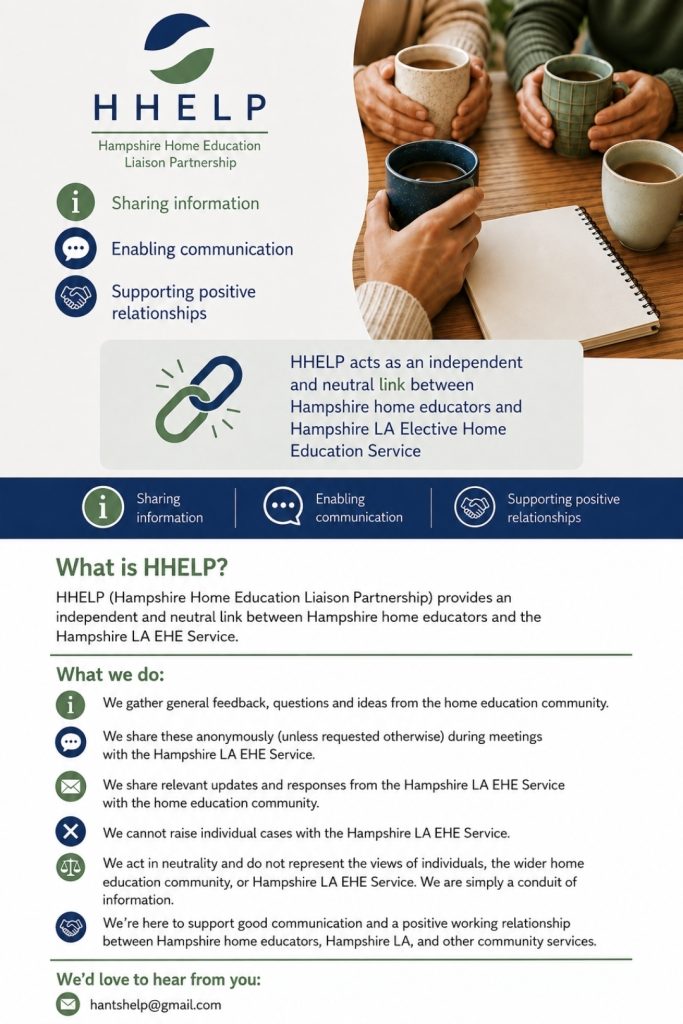
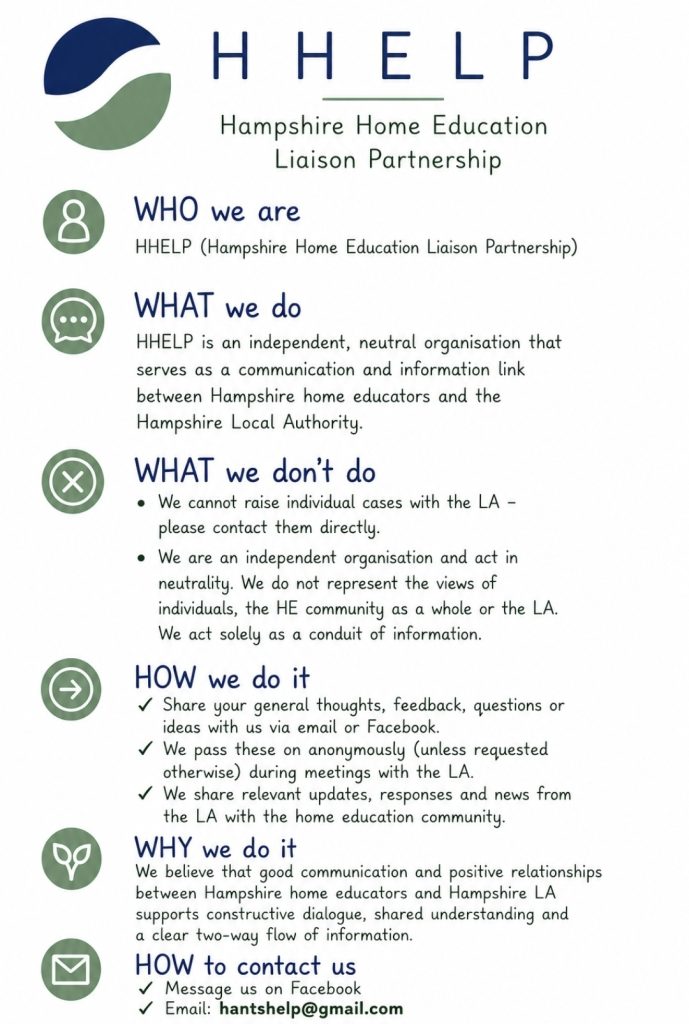
- Hampshire Home Education Liaison Partnership (H HELP) is an independent organisation to help create positive links and communication between the Home Education Community the Local Authority. You can follow their Facebook page here or read more on their leaflet below.